A sample can be pure, correctly identified and still carry bacterial endotoxin. It is invisible, it survives the conditions that kill bacteria, and it does not show up on an HPLC trace. That is why it has its own test.
Key takeaways
- Endotoxins are lipopolysaccharides (LPS) from the outer membrane of gram-negative bacteria.
- They are measured with the LAL (Limulus Amebocyte Lysate) test, described in USP <85>.
- Results are given in endotoxin units (EU), per mg or per mL.
- A sterile sample can still contain endotoxin: sterility and endotoxin are separate tests.
What endotoxins are
Gram-negative bacteria carry LPS in their outer membrane. When the bacteria die or divide, those fragments are released. They are heat-stable and are not removed by filtration that removes the bacteria themselves. Water, reagents, glassware and handling during synthesis or filling can all introduce them.
How the LAL test works
LAL is made from the blood cells (amebocytes) of the horseshoe crab, which clot in the presence of endotoxin. USP <85> describes three ways to read that reaction:
- Gel-clot. A limit test: the mixture either forms a firm gel or it does not. It is the referee method in USP <85> when results disagree.
- Turbidimetric. Measures the cloudiness that develops as the reaction proceeds. Endpoint or kinetic.
- Chromogenic. The reaction cleaves a synthetic substrate that releases a yellow color, read on a plate reader. Endpoint or kinetic.
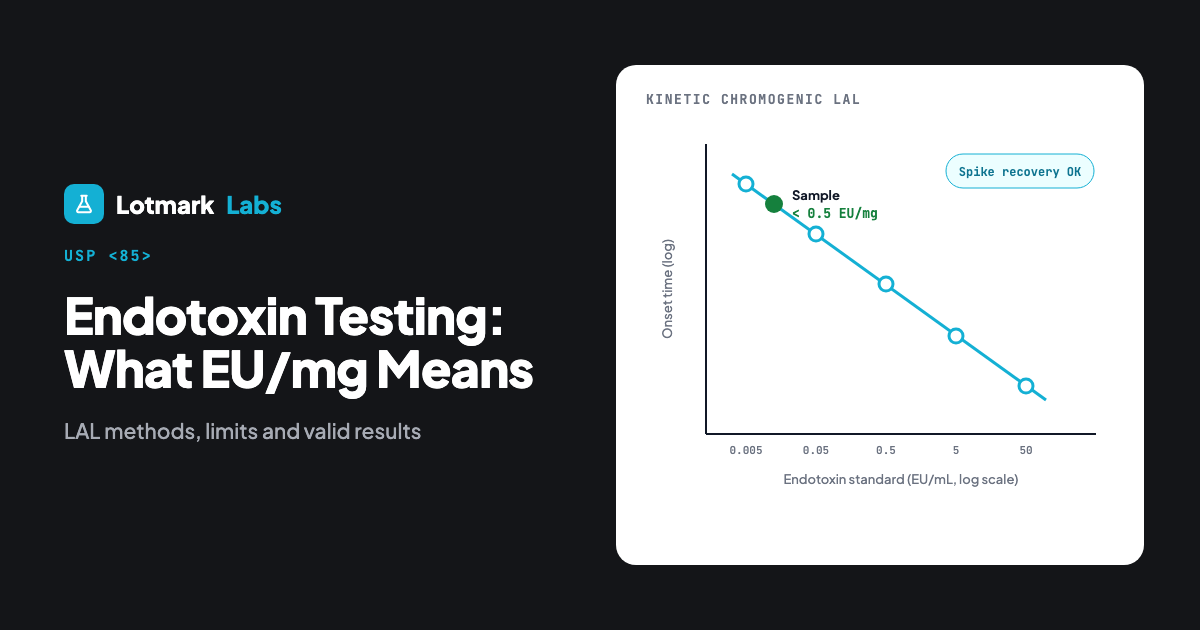
Kinetic chromogenic methods are widely used for quantitative results: the time taken to reach a set color is compared with a standard curve built from known endotoxin concentrations.
Recombinant reagents based on recombinant Factor C (rFC) are an animal-free alternative that some pharmacopeias now recognize; check which method your lab uses and whether it suits your purpose.
What EU/mg means
An endotoxin unit (EU) is a measure of endotoxin activity, standardized against a reference endotoxin. A result such as "< 1.0 EU/mg" means less than one endotoxin unit was found per milligram of sample, at the sensitivity the test achieved.
The "<" matters. Many results are reported as below a value, which is set by the test's sensitivity and how much the sample had to be diluted.
Interference, dilution and validity
Peptide samples can inhibit or enhance the LAL reaction (through pH, chelation or other effects). USP <85> requires the lab to show the test still works in the presence of the sample, using a positive product control: a known amount of endotoxin is added (spiked) to the sample and must be recovered within an accepted range.
If the sample interferes, it is diluted until it does not, but only up to the maximum valid dilution (MVD), which depends on the limit being tested against and the sensitivity of the lysate. That is why a result's detection floor can vary between samples.
How endotoxin limits are set
For pharmaceutical products, the general formula in USP <85> is K/M: K is a threshold dose of endotoxin per kilogram of body weight (5 EU/kg for most parenteral routes, lower for intrathecal), and M is the product's maximum dose per kilogram per hour. Specific products also have limits in their own monographs.
Research materials have no monograph limit. The lab reports the measured value; whether it is acceptable depends on the specification the buyer sets for the work. Decide that specification before you test.
Reading an endotoxin result on a COA
Look for:
- The method (gel-clot, turbidimetric, chromogenic; kinetic or endpoint; LAL or recombinant).
- The result with units (EU/mg or EU/mL), including any "<".
- Evidence the test was valid: positive product control recovery, or a statement that it met USP <85> requirements.
Frequently asked questions
If a sample passes sterility, is it endotoxin-free? No. Dead bacteria leave endotoxin behind. They are separate tests.
Why is the result "less than" a number? The test can only see down to its sensitivity at the dilution used. "< 0.5 EU/mg" means nothing was detected at that level.
Can endotoxin be removed from a finished peptide? It is difficult. Prevention through clean materials and handling is far more effective than removal.
Lotmark Labs runs bacterial endotoxin testing per USP <85> and reports results in EU/mg on every Full QC Panel. See the panels.