Endotoxin testing looks for the remains of bacteria. Sterility testing looks for anything still alive. The traditional test is slow by design, and newer rapid methods can cut the wait, provided they are properly validated.
Key takeaways
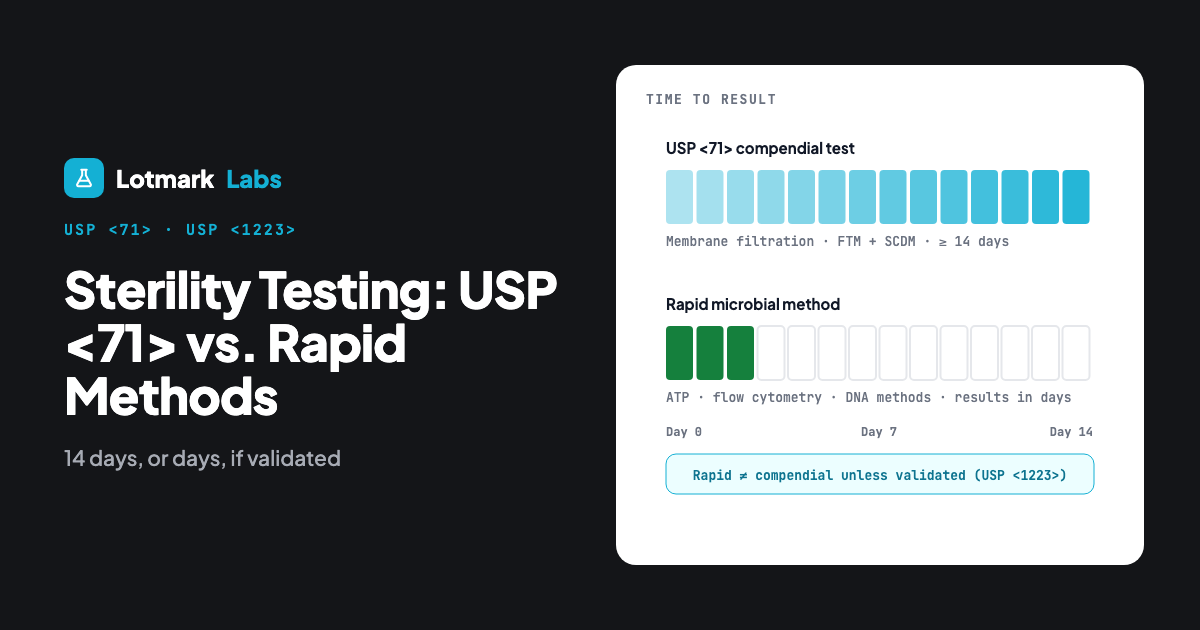
- The compendial test is USP <71>: samples go into growth media and are watched for at least 14 days.
- Rapid microbial methods (ATP, flow cytometry, nucleic-acid and microarray methods) can give results in days.
- A rapid method must be validated as equivalent under USP <1223> before it replaces <71> for release testing.
- A pass means no growth was found in the units tested; it is statistical evidence, not a guarantee for every unit.
How USP <71> works
USP <71>, harmonized with the European and Japanese pharmacopeias, uses two approaches:
- Membrane filtration (preferred when the sample allows): the sample is passed through a filter fine enough to trap microbes, and the filter is placed in growth media.
- Direct inoculation: the sample goes straight into the media, used when it cannot be filtered.
Two media cover the range of organisms:
- Fluid thioglycollate medium (FTM): for anaerobic and aerobic bacteria.
- Soybean–casein digest medium (SCDM / TSB): for aerobic bacteria and fungi.
The containers are incubated for not less than 14 days and checked for cloudiness (turbidity), which signals growth. Some organisms grow slowly, which is why the test cannot be shortened by simply looking sooner.
Method suitability
Before a product can be tested, the lab shows that the product itself does not stop microbes from growing (some samples are antimicrobial). This method suitability test spikes small numbers of reference organisms into the sample and checks they still grow. Without it, a "no growth" result could just mean the sample suppressed growth.
Rapid microbial methods
Rapid methods detect microbes without waiting for visible growth. Common technologies:
- ATP bioluminescence: living cells produce ATP, which drives a light reaction.
- Flow cytometry: labeled cells are counted one by one.
- Nucleic-acid methods (PCR, microarrays): detect microbial DNA or RNA signatures for a broad panel of organisms.
They can return results in a few days instead of two weeks. The trade-off is validation: USP <1223> sets out how to show an alternative method is at least as good as the compendial one for the intended use (specificity, limit of detection, robustness and so on). A rapid method without that validation is a screen, not a replacement.
What a sterility result proves (and doesn't)
A sterility test samples a limited number of units. If a batch had a low rate of contamination, a small sample could miss it. That is why sterile drug products rely on validated sterilization and aseptic processing, with the sterility test as a final check rather than the only one.
For research materials, a sterility result tells you no viable organisms were detected in what was tested, by that method, at that time.
Reading a sterility result on a COA
- The method: USP <71> (membrane filtration or direct inoculation) or a named rapid method.
- Media and incubation for compendial tests.
- Result: "No growth" / "Negative" or "Growth detected", with any identification.
- Validation: method suitability performed, or the rapid method's validation status.
Frequently asked questions
Why does USP <71> take so long? Some organisms grow slowly. Fourteen days gives them time to show.
Is a rapid sterility screen as good as USP <71>? Only if it has been validated as equivalent for that use under USP <1223>. Otherwise, treat it as a fast screen.
Does a sterile result mean no endotoxin? No. Endotoxin comes from dead bacteria too. See Endotoxin Testing (USP <85>).
Lotmark Labs offers a sterility screen as part of the Full QC Panel. See the panels or ask us about the method.