Purity tells you about the peptide. It says nothing about the metals that can come along with it: traces from catalysts, reagents, water and equipment used during synthesis and purification. Those are measured separately, and today the standard tool is ICP-MS.
Key takeaways
- Heavy metals are now called elemental impurities in pharmaceutical standards.
- USP <232> sets limits, USP <233> describes the test procedures, and both follow ICH Q3D.
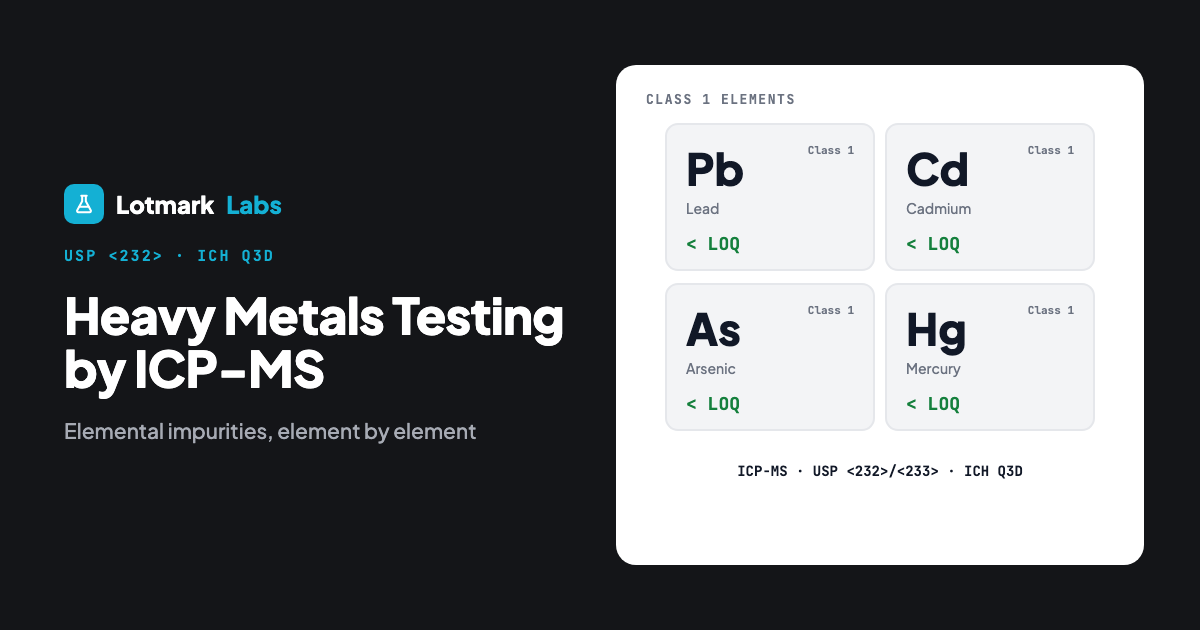
- The most toxic group, Class 1, is lead, cadmium, arsenic and mercury.
- ICP-MS measures many elements at once, at parts-per-billion levels.
From "heavy metals" to elemental impurities
For decades, pharmacopeias used a colorimetric "heavy metals" limit test (the old USP <231>). It produced one rough result for a group of metals and could not tell them apart at the low levels that matter. It was replaced by element-specific testing:
- ICH Q3D (an international guideline) sets permitted daily exposures (PDEs) for 24 elements, assessed by risk.
- USP <232> sets the corresponding limits in the US.
- USP <233> describes the analytical procedures and how to validate them.
- USP <2232> covers dietary supplements separately.
The element classes
ICH Q3D groups elements by toxicity and how likely they are to be present:
| Class | Elements | Why it matters |
|---|---|---|
| 1 | Cadmium, lead, arsenic (inorganic), mercury | Most toxic; assessed for every product |
| 2A | Cobalt, nickel, vanadium | Relatively likely to be present |
| 2B | Silver, gold, iridium, osmium, palladium, platinum, rhodium, ruthenium, selenium, thallium | Less likely unless added on purpose, e.g. as catalysts |
| 3 | Barium, chromium, copper, lithium, molybdenum, antimony, tin | Lower oral toxicity |
For the Class 1 elements, the oral PDEs are 5 µg/day for cadmium and lead, 15 µg/day for inorganic arsenic and 30 µg/day for mercury. Limits for other routes are lower for some elements. Always check the current ICH Q3D(R2) and USP-NF text before using any figure as a specification.
How ICP-MS works
Inductively coupled plasma mass spectrometry starts by digesting the sample, usually in acid, so the metals are in solution. The solution is sprayed into an argon plasma at roughly 6,000–10,000 K, which breaks everything down into atoms and ionizes them. A mass spectrometer then separates and counts the ions by mass.
Why labs use it:
- Sensitivity: parts per billion (µg/kg) or lower.
- Many elements in one run.
- Element-specific results, unlike the old colorimetric test.
Labs control for interferences (molecular ions with the same mass as an element of interest) with collision/reaction cells and internal standards, and they check recovery with spiked samples.
Where metals come from in peptide work
- Catalysts and reagents used in synthesis and deprotection.
- Water and solvents used in purification.
- Equipment: stainless steel, tubing, glassware.
- Packaging: vials and stoppers, in some cases.
Copper, zinc, iron and nickel turn up from equipment and reagents; lead and cadmium are the ones every report should cover.
Reading a heavy metals result on a COA
A clear result names the method (ICP-MS), lists each element tested, gives the result with units (µg/g, ppm or ppb), and states the reporting limit. Results below that limit appear as "< LOQ" or "< 0.05 µg/g".
Be cautious with a single line saying "heavy metals: pass" with no elements, units or method. That is the old-style answer, and it tells you very little.
Frequently asked questions
What does "ppm" mean here? Parts per million, the same as µg per gram of sample. Parts per billion (ppb) is µg per kilogram.
Do research peptides have to meet USP <232>? Those limits are written for drug products. For research materials they are a widely used reference point; the specification is set by the buyer.
Is ICP-OES the same as ICP-MS? Both are allowed by USP <233>. ICP-MS reaches lower levels and is the usual choice for Class 1 elements.
Lotmark Labs screens for heavy metals by ICP-MS as part of the Full QC Panel. See the panels or request a quote.