"ISO 17025 accredited" is one of the strongest things a testing lab can say about itself, and one of the easiest to misuse. Here is what it means, what it doesn't, and how to check it in five minutes.
Key takeaways
- ISO/IEC 17025 is the international standard for the competence of testing and calibration labs.
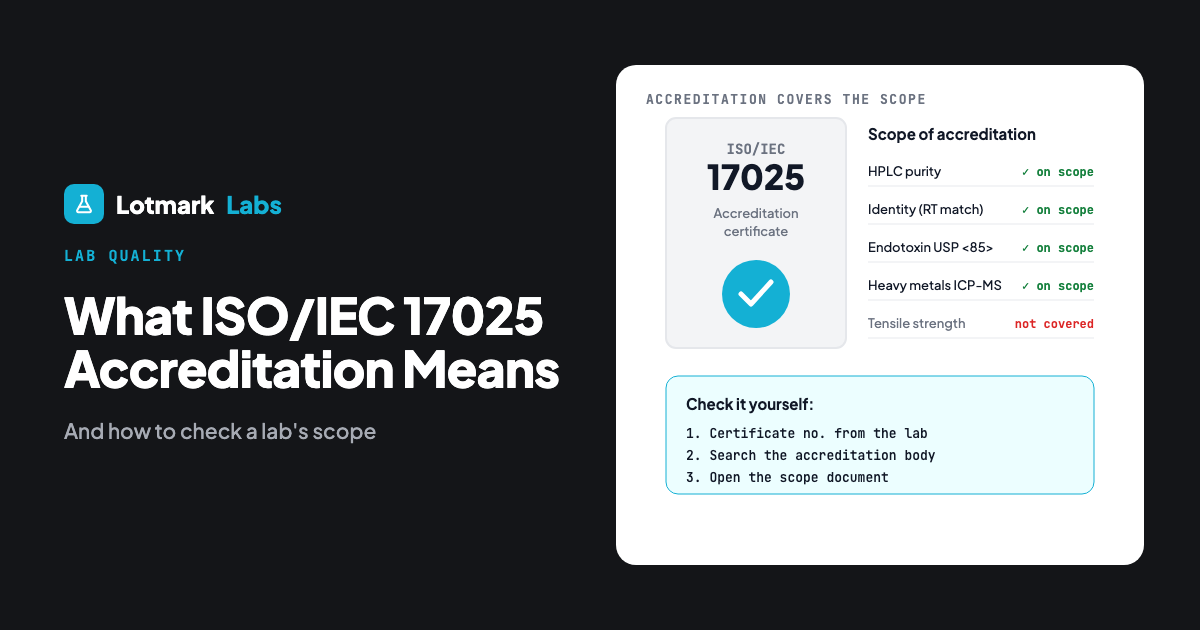
- Accreditation covers only the tests listed on the lab's scope, not everything the lab does.
- ISO 9001 certification is different: it covers a quality management system, not technical competence.
- Verify accreditation with the accreditation body's directory, not the lab's logo.
What ISO/IEC 17025 covers
The current edition, ISO/IEC 17025:2017, sets requirements in two broad areas:
- Management: impartiality, confidentiality, document control, handling complaints, corrective action.
- Technical: trained and qualified staff, validated or verified methods, calibrated equipment with traceability to recognized standards, measurement uncertainty, proficiency testing, and how results are reported.
An independent accreditation body assesses the lab against the standard, on site, and keeps reassessing it.
Accreditation vs. certification
These words are not interchangeable:
| ISO/IEC 17025 accreditation | ISO 9001 certification | |
|---|---|---|
| What it assesses | Technical competence for specific tests | A quality management system |
| Who grants it | An accreditation body (e.g. A2LA, ANAB, PJLA) | A certification body |
| Covers results? | Yes, for tests on the scope | No |
A lab that is "ISO 9001 certified" may run good processes, but that certificate says nothing about whether its HPLC results are technically sound.
The scope is everything
Accreditation is granted against a scope of accreditation: a published list of the specific tests, methods, sample types and ranges the lab has shown it can do competently. A lab accredited for microbiology is not thereby accredited for HPLC purity. If the test you need is not on the scope, the accreditation does not cover your result.
Accredited labs often mark which results on a report fall inside their scope.
How to check a lab in five minutes
- Get the details from the lab: the legal entity name, site address and accreditation certificate number.
- Find the accreditation body's directory. In the US the common bodies include A2LA, ANAB, PJLA and NIST's NVLAP. Search the directory by name or certificate number.
- Match the legal entity and site. The certificate should name the same company and location that tests your samples, not just a parent brand.
- Open the scope document. Confirm the test you are ordering, the method, and the sample type are listed, and that the certificate is current.
- Check the accreditation body itself is a signatory to the international mutual recognition arrangement (ILAC MRA), which is what lets results be accepted across borders.
Questions worth asking any lab
- Is this specific test on your scope?
- When was your last assessment?
- Do you take part in proficiency testing for this method?
- How do you report measurement uncertainty?
- Will you confirm a report's authenticity if a third party asks?
Frequently asked questions
Can a lab be partly accredited? Yes. Most are. The scope lists exactly which tests are covered.
Does accreditation guarantee a result is right? No standard can. It shows the lab has demonstrated competence and runs controls that make errors less likely and easier to catch.
Is "ISO certified" the same as "ISO 17025 accredited"? No. Ask which standard, and check it with the issuing body.
Ask any lab, including us, for its certificate number and scope, and check them with the issuing body. Lotmark Labs' accreditation status is listed on our home page. Contact us with questions.