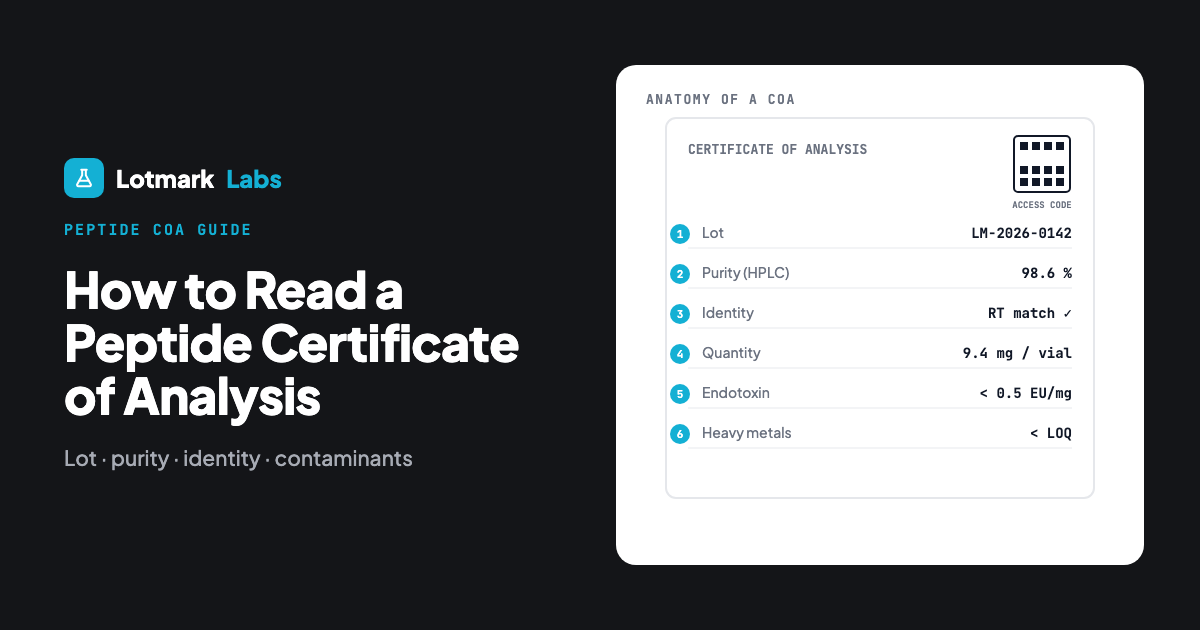
A Certificate of Analysis (COA) is the lab's record of what was tested, how, and what came out. For research peptides it answers two separate questions: is this the right molecule (identity), and how much of the material is that molecule (purity and quantity). A COA that only answers one of them is incomplete.
This guide walks through a COA from top to bottom, in the order you should read it.
Key takeaways
- Start with the lot number and dates. A perfect result for a different lot tells you nothing about your vial.
- Purity (HPLC area %) and identity (retention time match or mass spec) are different tests. You need both.
- Quantity is a third, separate result: how many milligrams of peptide are actually in the vial.
- Contaminant tests (endotoxin, heavy metals, sterility) only appear if they were ordered. Their absence is not a pass.
- A COA should name the lab and give you a way to verify it with that lab, not just with the seller.
1. The header: who, what and which lot
The top of a COA identifies the report. Check each of these before you look at a single number:
- Laboratory name and address. It should be a real, findable lab, and ideally not the company selling the product.
- Report or COA number. A unique ID the lab can look up.
- Sample description. What the client said the sample was, and its form (lyophilized powder, solution).
- Lot or batch number. It must match the label on the vial in front of you.
- Dates. When the sample was received, tested and released. Long-held stock should carry a re-test date.
- Client. Some reports name the brand that submitted the sample; some leave it off by request.
If the lot number is missing, or does not match your label, stop there. The rest of the report may be real, but it is not about your material.
2. Purity by HPLC
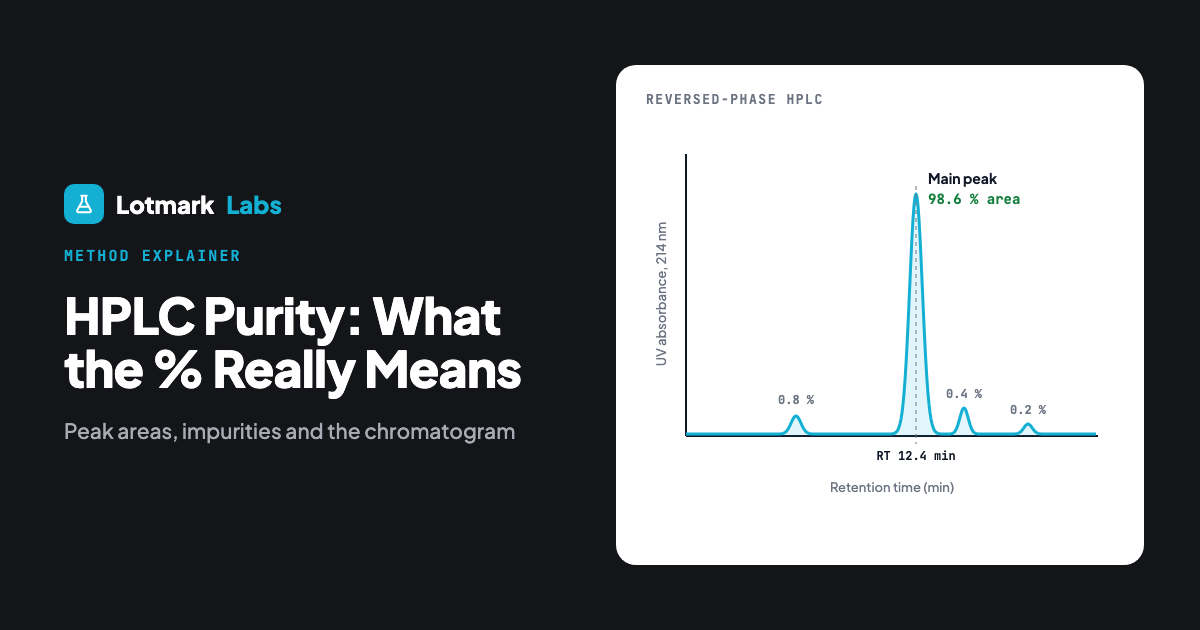
Purity is almost always measured by reversed-phase HPLC with UV detection, typically around 214–220 nm, where peptide bonds absorb light. The result is the area percentage of the main peak compared with every peak the method detected.
What to look for:
- The number and the chromatogram. A purity figure with the actual trace attached is far more useful than a number alone. A clean baseline and one dominant peak is what you hope to see; shoulders or peaks close to the main one are worth a second look.
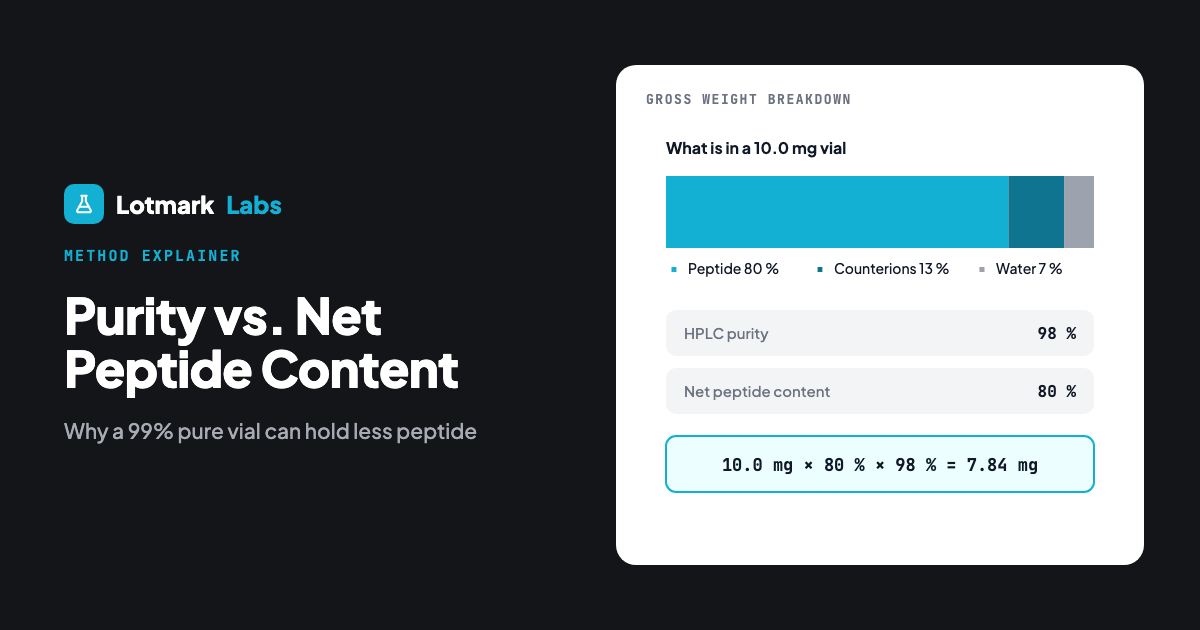
- What it leaves out. HPLC purity only compares peptide-related material that absorbs at that wavelength. It does not measure water, salts, counterions, endotoxin or metals. A "99% pure" vial can still be 20% something else by weight.
We cover this in depth in HPLC Purity Testing Explained.
3. Identity
Purity tells you something in the vial is clean. Identity tells you it is the compound on the label. Two common approaches:
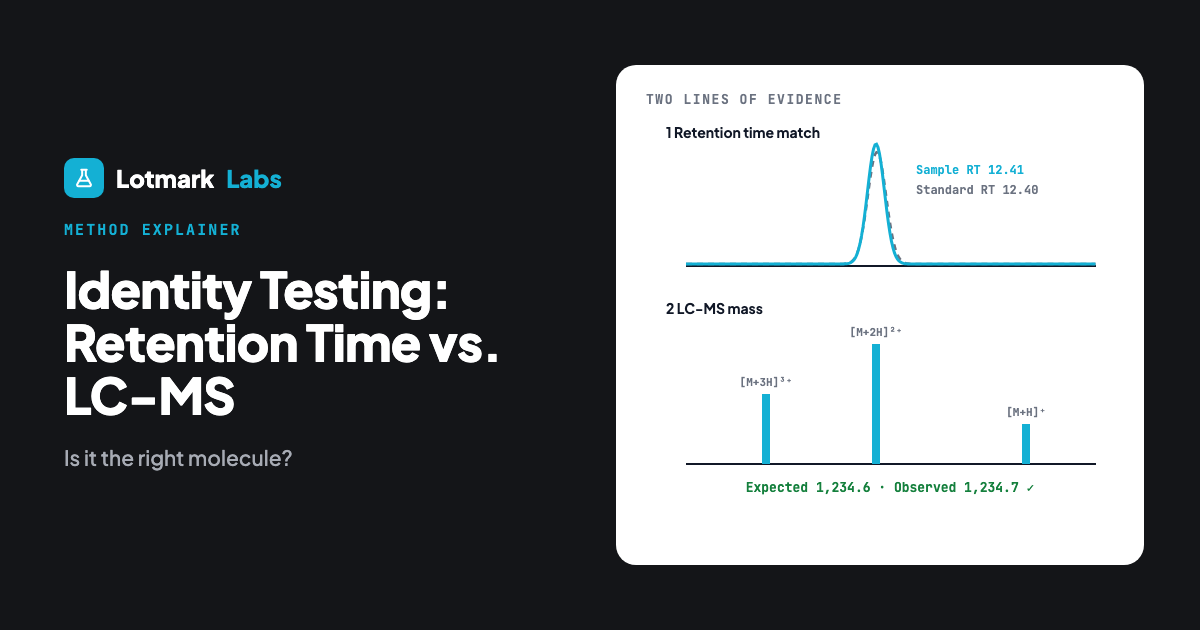
- HPLC retention time match. The sample's main peak elutes at the same time as a certified reference standard run under the same conditions.
- Mass spectrometry (LC-MS). The observed mass is compared with the theoretical mass of the expected sequence, within the instrument's stated tolerance.
Be wary of a line that only says "MS: conforms" with no expected and observed values. See Peptide Identity Testing: Retention Time vs. LC-MS.
4. Quantity (content per vial)
Quantity answers "how many milligrams are actually in here?" It is usually reported in mg per vial, and sometimes as a percentage of the amount on the label. It is measured against a reference standard, so the quality of that standard matters.
Quantity and purity can disagree in surprising ways. A vial can be very pure and still hold less peptide than the label says. Purity vs. Net Peptide Content explains why.
5. Contaminant tests
These appear only when the client ordered them:
| Test | What it looks for | Typical method |
|---|---|---|
| Endotoxin | Fragments of gram-negative bacteria (lipopolysaccharide) | LAL methods per USP <85>, reported in EU/mg |
| Heavy metals | Elemental impurities such as lead, cadmium, arsenic, mercury | ICP-MS per USP <232>/<233> |
| Sterility | Living microorganisms | Compendial USP <71> or a validated rapid method |
A COA without these sections is not a "pass" for them. It means nobody asked.
6. The signature and the verification route
The bottom of a good COA names the analyst or approver, and gives you a way to confirm the report is genuine: a QR code, an access code, or a report number you can check with the lab directly. Lotmark Labs prints an access code on every certificate; anyone can enter it on our COA verification page to see the record as we released it.
A 60-second COA checklist
- Lab named, and independent of the seller?
- Lot number matches your vial?
- Test date recent and close to production?
- Purity reported, with a chromatogram?
- Identity confirmed, with expected and observed values?
- Quantity reported in mg?
- Contaminant tests present if you need them?
- A way to verify the report with the lab itself?
Frequently asked questions
Is 98% purity good? It depends on what you need it for, but 98% by HPLC area is a common benchmark for research-grade peptides. The number only means something alongside the method, the chromatogram and an identity result.
Why does my COA not list endotoxin? Endotoxin is a separate test that has to be ordered. If it is not on the report, it was not tested.
Can a COA be faked? Yes. Edited PDFs and reused reports are common. See How to Spot a Fake or Altered COA, and always verify with the lab that issued it.
Lotmark Labs is an independent analytical testing lab in San Diego. If you need a lot tested, request a quote or see our peptide testing panels.