Almost every product page now says "lab tested." The question that matters is: tested by whom, and was it this lot? Here is why independence and lot specificity carry so much weight, and how to get third-party testing done well.
Key takeaways
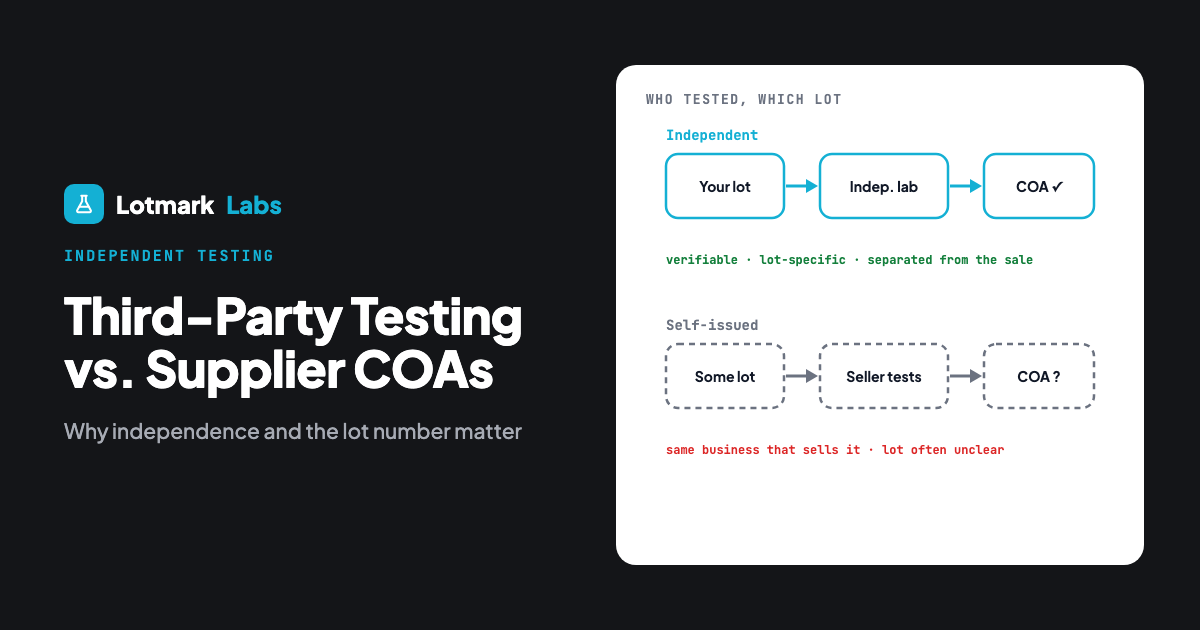
- A supplier's own COA comes from the same business that made and sells the product. That is a conflict of interest, whatever the intent.
- Third-party testing separates the verification from the sale.
- A COA only describes the lot it tested. Lot-to-lot variation is normal.
- Chain of custody (who took the sample, from where) decides what a result actually proves.
Supplier COA, manufacturer COA, third-party COA
| Source | Who tests | Strength | Weakness |
|---|---|---|---|
| Supplier in-house | The seller's own lab or staff | Fast, cheap, routine | Not independent |
| Manufacturer's COA passed on | The maker, often overseas | Better than nothing | Seller can't vouch for it; often unverifiable |
| Third-party | An independent lab | Separated from the sale; verifiable | Costs money and time |
In-house QC is valuable for a manufacturer's own process control. It just isn't independent evidence for a buyer.
Why every lot needs its own result
Peptides are made in batches, and no two batches are identical. Purity, peptide content, water, counterions and contaminants can all vary from lot to lot. Something can also go wrong after production: in storage, in transit, or when material is re-packed into smaller vials.
So a good result for Lot A tells you nothing about Lot B. The useful question for any COA is: is this the lot in my hands?
Chain of custody: who took the sample?
What a result proves depends on where the sample came from:
- Sent by the manufacturer: shows what the manufacturer chose to send.
- Sent by the seller from stock: shows that lot as the seller holds it.
- Bought from the open market and sent by an independent party: the strongest evidence of what buyers actually receive.
A good report records who submitted the sample and the lot it came from, so readers can judge for themselves.
Testing the batch, not the brand
Many brands sell material from the same production lot. One independent test of the lot can support several brands' listings, provided each listing really carries that lot. This is the reason Lotmark Labs can issue additional-brand COAs for the same tested lot: the testing is about the material, not the label.
How to submit samples for third-party testing
- Decide your tests first. Purity and identity at minimum; add quantity, endotoxin, heavy metals and sterility if the work needs them.
- Set your specification in advance, e.g. purity ≥ 98%, endotoxin below a set EU/mg. Decide before you see results.
- Send enough material. Separate vials for chemistry, endotoxin and sterility help avoid contaminating one test with another. Ask the lab for its minimums.
- Keep vials sealed and labeled with the lot number as it appears on the product.
- Include the paperwork the lab asks for, such as a packing slip or order number.
- Ship to arrive on a weekday, and protect lyophilized material from heat and moisture.
Frequently asked questions
Is a supplier COA worthless? No. It is a starting point. It is simply not independent, and it may not be for your lot.
How often should a lot be re-tested? At release, and again if it has been stored for a long time, moved between facilities or re-packaged.
Can one test cover several brands? Yes, if they genuinely sell the same lot. The certificate should name the lot clearly so any brand's buyers can match it.
Lotmark Labs is an independent analytical lab in San Diego. See our peptide testing panels, verify a COA, or request a quote.