A purity result says something in the vial is clean. It does not say what that something is. Identity testing answers the second question: is the main component the compound on the label? There are two common ways to show it, and they are strongest together.
Key takeaways
- Retention time matching compares the sample with a certified reference standard on the same HPLC run conditions.
- LC-MS compares the measured mass with the expected mass of the sequence.
- Each method can be fooled in different ways, so they are complementary, not interchangeable.
- A good COA shows expected and observed values, not just "conforms."
Method 1: HPLC retention time match
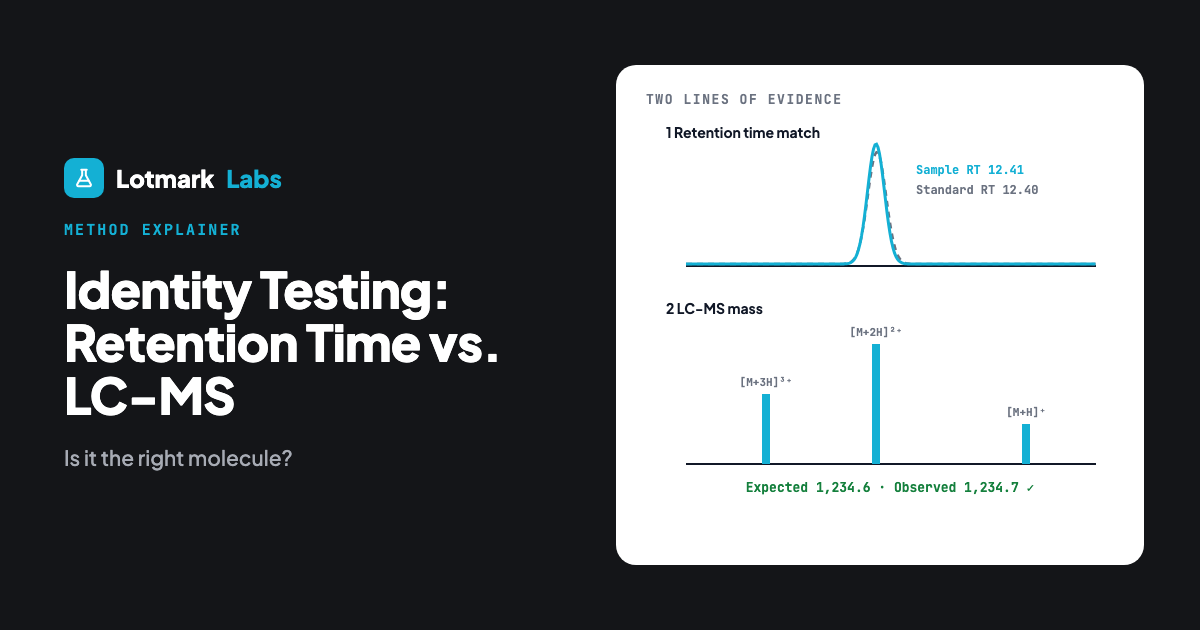
The sample and a certified reference standard of the expected compound are run under identical conditions. If the sample's main peak comes off the column at the same time as the standard's, within a set window, the identity is supported.
Strengths
- Uses the same run as purity, so it is efficient.
- Tied to a real, characterized standard.
Limits
- Different compounds can elute at nearly the same time. A match supports identity; it does not prove it on its own.
- It depends entirely on having a trustworthy reference standard.
Some labs strengthen it by spiking: mixing sample and standard. A single, sharper peak (rather than two close ones) adds confidence.
Method 2: LC-MS mass confirmation
In liquid chromatography–mass spectrometry (LC-MS), molecules leaving the HPLC column are ionized, commonly by electrospray, and their mass-to-charge ratio (m/z) is measured.
Peptides usually pick up several protons, so one peptide shows up as a family of peaks: [M+H]⁺, [M+2H]²⁺, [M+3H]³⁺ and so on. Software can deconvolute these into a single neutral mass, which is compared with the theoretical mass of the sequence.
Reading the result
- Expected (theoretical) mass: calculated from the sequence and any modifications.
- Observed mass: what the instrument measured.
- Tolerance: how close they must be. It depends on the instrument's resolution.
- Convention: monoisotopic or average mass. The expected value must use the same one.
Strengths
- Directly tied to the molecule's composition.
- Can reveal impurities hiding under a UV peak, because they have different masses.
Limits
- Molecules with the same mass look the same: a scrambled sequence of the same amino acids, or a single amino acid flipped to its mirror-image form.
- Ion suppression and adducts (sodium, potassium) can complicate the spectrum.
When even more certainty is needed, tandem mass spectrometry (MS/MS) fragments the peptide and reads back parts of the sequence.
Which one should you order?
| Question | Retention time match | LC-MS |
|---|---|---|
| Matches a known standard? | Yes | Indirectly |
| Correct molecular mass? | No | Yes |
| Catches co-eluting impurity of different mass? | No | Often |
| Distinguishes same-mass isomers? | Sometimes | No (without MS/MS) |
For routine lot release, a retention time match against a good standard plus HPLC purity is a common baseline. LC-MS adds an independent line of evidence, and is the better choice when there is no reliable standard, or when a result looks off.
Red flags on identity results
- "MS: conforms" with no expected or observed mass.
- An observed mass that matches the expected one to an implausible number of decimal places for the instrument used.
- Identity reported with no method named.
- A purity result with no identity test at all.
Frequently asked questions
Can a vial pass purity and fail identity? Yes. A cleanly synthesized wrong sequence would show high purity and fail identity.
Is LC-MS always better? It answers a different question. Mass confirms composition; a retention time match against a standard confirms behavior. Together they are stronger than either.
What does "deconvoluted mass" mean? The neutral mass calculated from the several charge states a peptide shows in the spectrum.
Lotmark Labs confirms identity by HPLC retention time match, with LC-MS available as an add-on. See the peptide panels.