Two numbers on a peptide COA are easy to confuse: purity and net peptide content. They measure different things, and the difference can be large enough to matter in any calculation that depends on how much peptide you actually have.
Key takeaways
- Purity (HPLC) is the share of the peptide-related material that is the target peptide.
- Net peptide content is the share of the whole powder that is peptide at all.
- Lyophilized peptide powder also contains counterions (often TFA or acetate) and water.
- To estimate the target peptide in a vial: gross weight × net peptide content × purity.
What is actually in the vial
Freeze-dried peptide is never 100% peptide by weight. Alongside the peptide you will usually find:
- Counterions. Peptides purified by reversed-phase HPLC with trifluoroacetic acid (TFA) end up as TFA salts: TFA ions pair with the positively charged groups on the peptide. Some products are exchanged to acetate or chloride salts instead.
- Water. Lyophilized peptides are hygroscopic and hold residual and absorbed moisture.
- Residual solvents and salts from synthesis and purification.
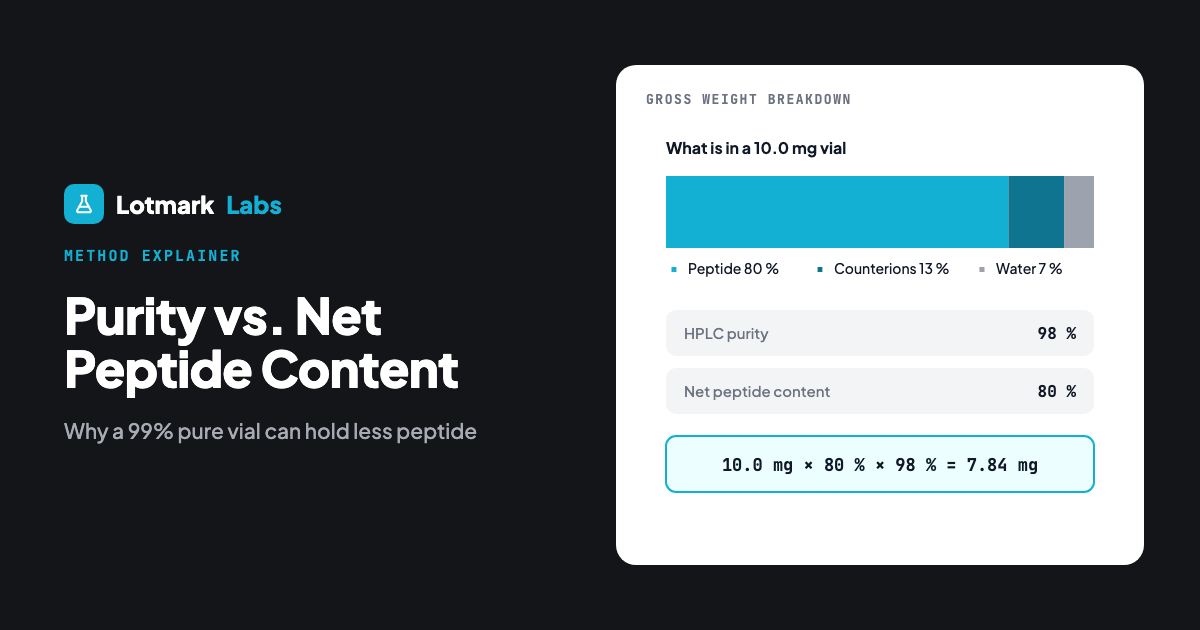
The total weight of all of that is the gross weight. The peptide's share of it is the net peptide content, often reported as a percentage.
Why purity does not capture this
HPLC purity is calculated from UV peaks of peptide-related material. Counterions, water and inorganic salts either do not appear as peaks or are not counted in that comparison. So a vial can be 99% pure and still be, say, 75% peptide by weight.
Neither number is wrong. They answer different questions.
How net peptide content is measured
Labs use one or more of:
- Amino acid analysis (AAA): the peptide is broken down into amino acids, which are quantified.
- Elemental (nitrogen) analysis: peptide content is calculated from nitrogen, which comes almost entirely from the peptide.
- Quantitation by HPLC against a reference standard of known content.
The pieces that are not peptide can be measured separately too: ion chromatography for counterions and Karl Fischer titration for water.
A worked example
Suppose a vial is labeled 10 mg, and the COA reports:
- Gross weight: 10.0 mg of powder
- Net peptide content: 80%
- HPLC purity: 98%
Then:
- Peptide in the vial: 10.0 mg × 0.80 = 8.0 mg
- Target peptide: 8.0 mg × 0.98 = 7.84 mg
The other 2.16 mg is counterions, water, salts and a small amount of related impurities.
How much can counterions weigh?
A rough upper estimate comes from molecular weights. If a peptide with a molecular weight of 1,000 binds two TFA ions (about 114 each), the salt weighs about 1,228, so the peptide is roughly 1,000 ÷ 1,228 ≈ 81% of it before any water is counted. Peptides with more basic residues bind more counterions, and the share drops further.
Why it matters for research
- Concentrations. If you dissolve a vial and assume the label weight is all peptide, every concentration you calculate is high.
- Comparing batches. Two lots with the same purity can carry different amounts of peptide. Comparing by gross weight hides that.
- Comparing suppliers. One label may state gross weight, another peptide content. Ask which.
What to ask for on a COA
- A quantity result in mg per vial, measured against a reference standard.
- Or a net peptide content percentage with the method named.
- The salt form (TFA, acetate, HCl) if it is known.
Frequently asked questions
Is low net peptide content a sign of a bad product? Not by itself. 70–90% is common for many salt forms. It is a sign the label weight should not be read as peptide weight.
Does purity include the counterion? No. HPLC purity compares peptide-related peaks only.
Which number should I use for calculations? The measured peptide quantity or net peptide content, then adjust for purity if you need the target peptide alone.
Lotmark Labs reports purity and quantitation per vial on every Full QC Panel. See the panels or request a quote.