"98% pure" is the most quoted number in the peptide world, and one of the most misunderstood. It comes from high-performance liquid chromatography (HPLC), and it means something very specific. Here is what the test does, what the percentage measures, and what it can miss.
Key takeaways
- HPLC purity is the main peak's share of the total peak area at one detection wavelength.
- It compares peptide-related impurities only. Water, salts and counterions are not in the number.
- A purity figure is only as good as the method's ability to separate impurities from the main peak.
- Ask for the chromatogram, not just the percentage.
How reversed-phase HPLC works
A small amount of dissolved sample is injected onto a column packed with tiny particles coated in a water-repelling (hydrophobic) layer, usually C18. A mixture of water and an organic solvent such as acetonitrile flows through it, typically with a little trifluoroacetic acid (TFA) added. Over the run, the proportion of organic solvent increases (a gradient).
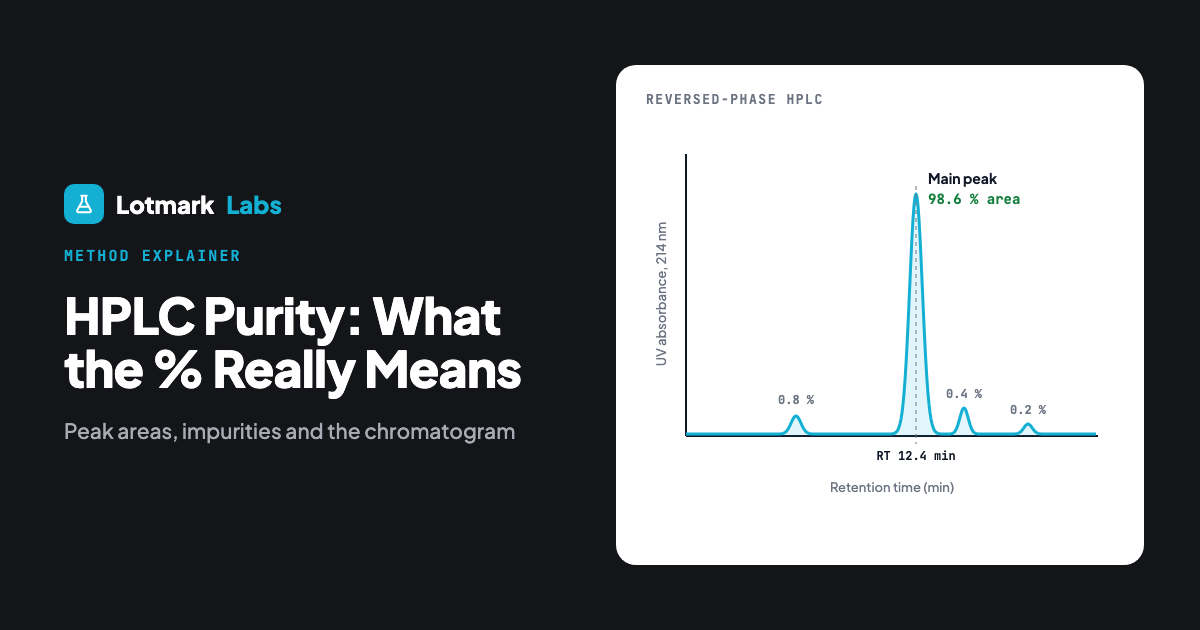
Each molecule sticks to the column to a different degree. The more hydrophobic it is, the later it washes off. As molecules leave the column they pass a UV detector, usually set around 214–220 nm, where the peptide bond absorbs light. The result is a chromatogram: a trace of detector signal against time, with a peak for each separated substance.
The time a substance takes to come off the column is its retention time.
Where the percentage comes from
Software integrates the area under each peak. Purity is then:
main peak area ÷ total area of all integrated peaks × 100
So "98.6% purity" means 98.6% of the UV-absorbing, peptide-related signal belonged to the main peak.
What the impurities usually are
Peptides are built one amino acid at a time, and each step can go slightly wrong. Common impurities include:
- Deletion sequences: one amino acid missing.
- Truncations: the chain stopped early.
- Incompletely deprotected forms: a protecting group left on.
- Oxidation (often at methionine) and deamidation (asparagine, glutamine).
- Racemization: an amino acid flipped to its mirror-image form.
Many of these are chemically very close to the target peptide, so they elute close to the main peak. Those are the hardest to separate and the easiest to miss.
What HPLC purity does not tell you
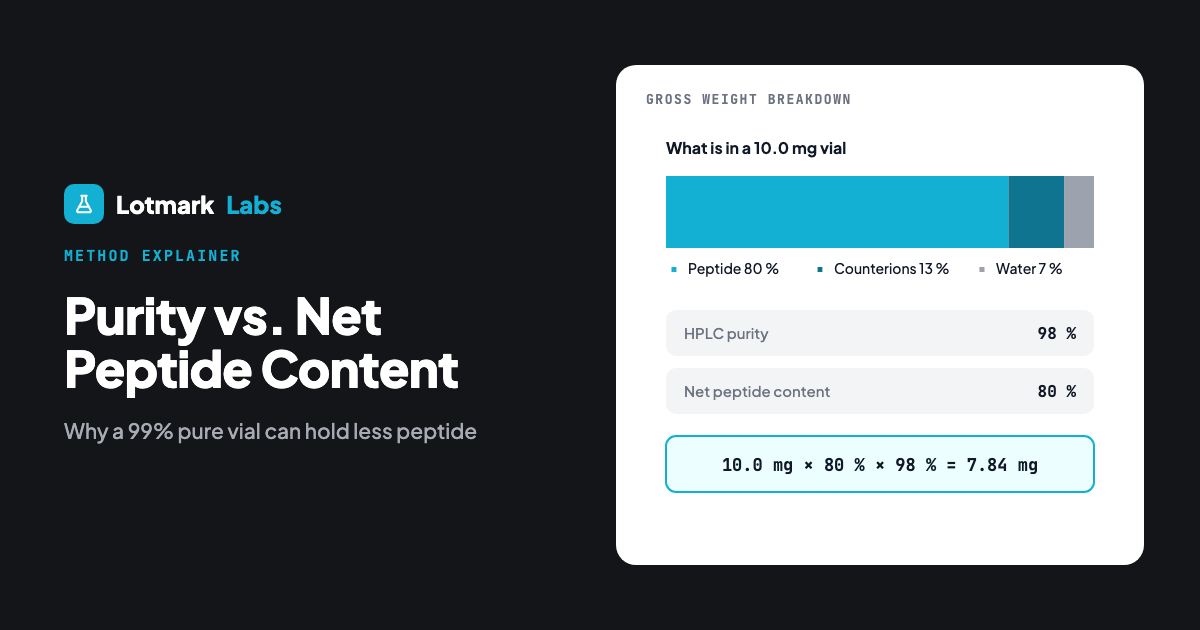
- How much peptide is in the vial. Purity is a ratio, not a weight. See Purity vs. Net Peptide Content.
- Water, salts and counterions. They do not show up as peaks the way peptide impurities do.
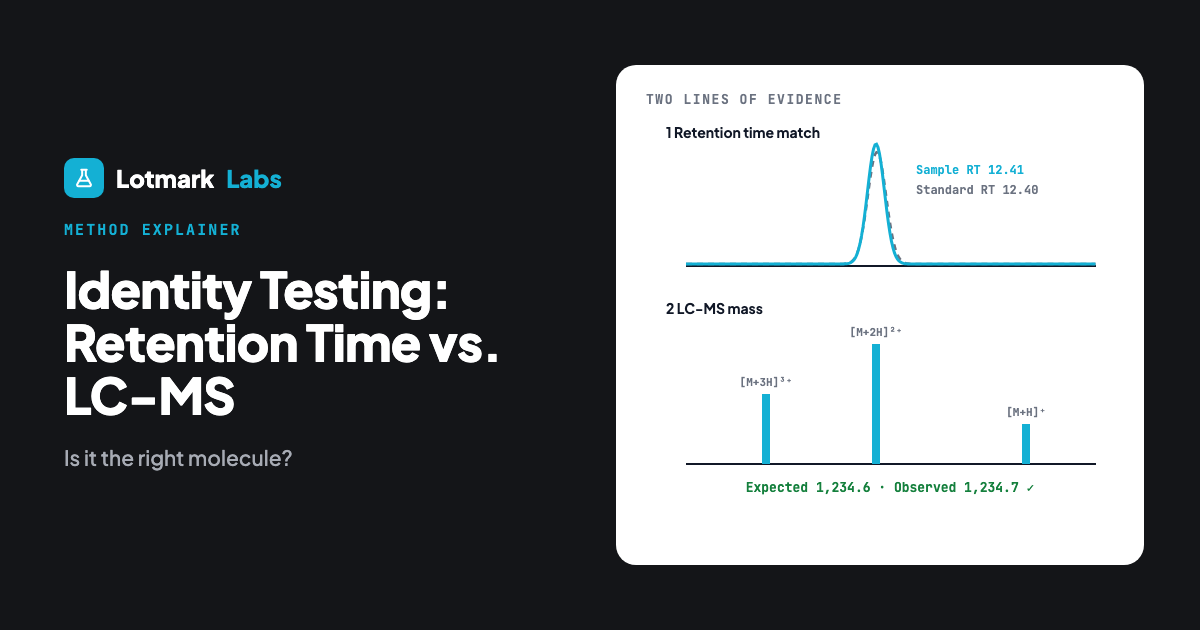
- Identity. A 99% pure peak could be 99% pure of the wrong compound. Identity needs its own test: retention time match or LC-MS.
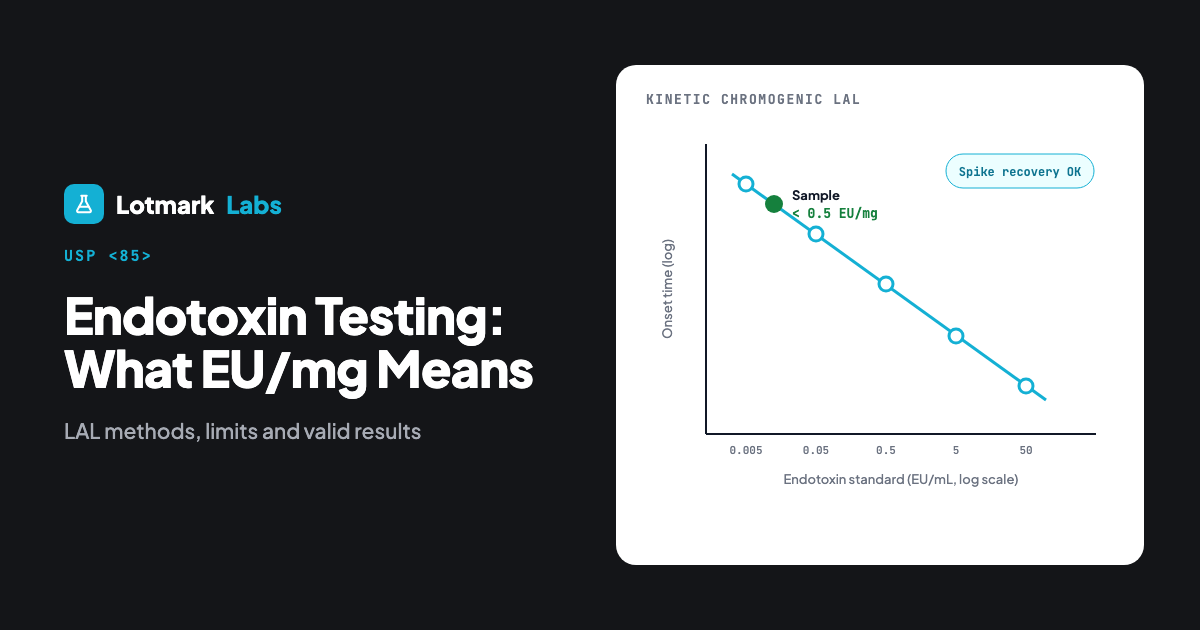
- Endotoxin, metals or microbes. These need endotoxin, ICP-MS and sterility testing.
Reading a chromatogram on a COA
When a COA includes the trace, look for:
- One dominant peak, sharp and symmetrical.
- A flat baseline before and after it.
- Shoulders on the main peak: a sign that something may be co-eluting and inflating the purity figure.
- Small peaks just before or after the main one: often closely related impurities.
- A peak table listing retention time and area % for every integrated peak, so the total adds up.
A suspiciously perfect result (a single peak, 100.0%, no table) is worth questioning. Real samples almost always show something.
Why method matters
Two labs can report different purities for the same lot and both be honest, because the result depends on the column, the gradient, the wavelength and how peaks are integrated. A method that is too fast can hide impurities under the main peak. Good practice is a method suited to the peptide, documented on the report, and run on a calibrated, maintained system. Pharmacopeial chapter USP <621> sets out general chromatography requirements and allowed adjustments.
When the stakes are high, labs confirm purity with an orthogonal method: a second, different separation (another column or gradient), or LC-MS, which can spot impurities hiding under the UV peak.
Frequently asked questions
Is HPLC purity the same as potency? No. Potency or quantity is how much of the peptide is present, measured against a reference standard. Purity is a ratio of peak areas.
Why do two COAs for the same lot show different purities? Different methods, integration settings or sample handling. A peptide that degraded in transit can also genuinely test lower later.
What purity should research peptides have? Many buyers set 98% as a minimum, but the right specification depends on the work. Set it before you test, not after.
Lotmark Labs runs reversed-phase HPLC for purity and quantitation on every Full QC and HPLC Panel. See our peptide panels or request a quote.